
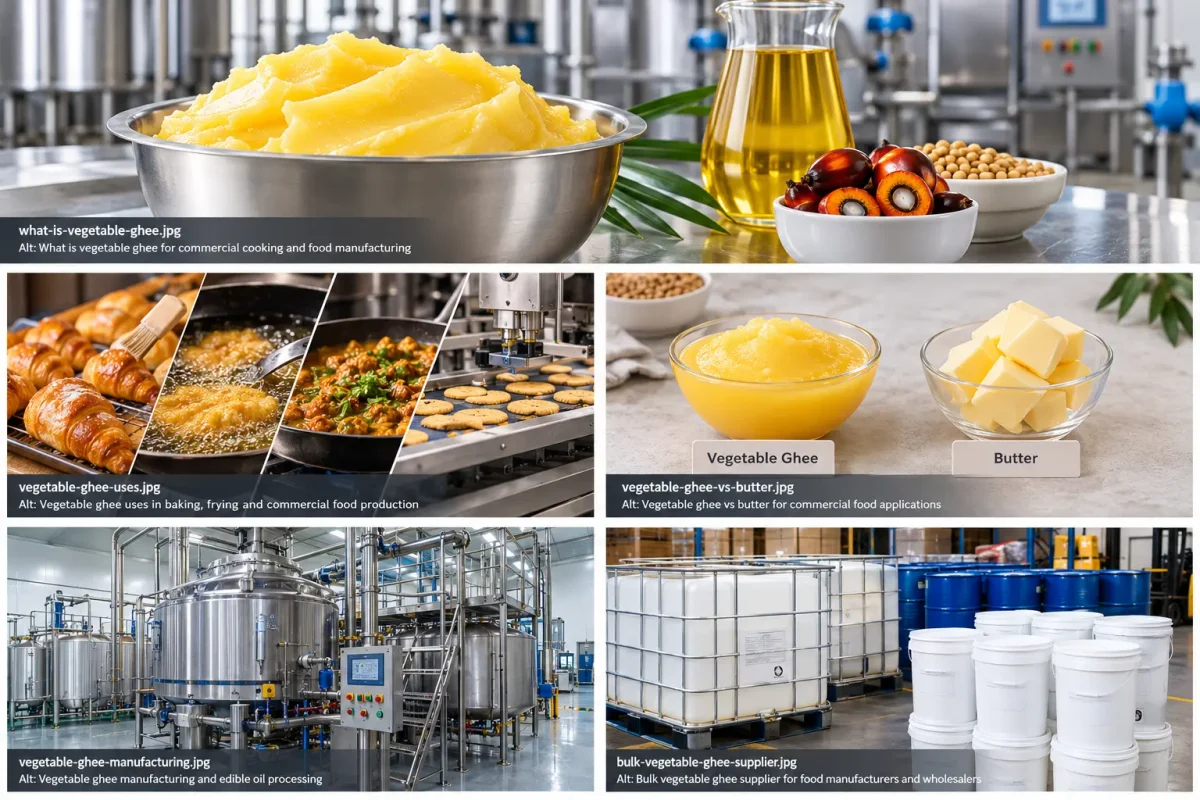
Vegetable ghee is a solid or semi-solid cooking fat that has been processed to give it a rich texture and suitable cooking properties. This is different from regular (dairy) ghee – it does not use milk fat as a base. Depending on formulation and specifications, it can be used in frying, baking, commercial cooking and food manufacturing applications.
Making the right choice in the type of cooking fat for your business doesn’t just mean shopping around for the cheapest one. You need consistent quality, performance, ingredient specifications and a reliable supply. For food manufacturing, bakeries, restaurants or wholesale distribution, the wrong type of fat can impact the texture, flavour, production consistency and cost of the product.
Knowledge of vegetable ghee, its applications and methods of preparation can assist in making decisions while buying ghee. It also enables you to evaluate suppliers by technical documentation, product suitability and commercial needs, and not just by price.
What Is Vegetable Ghee?
Vegetable ghee is a fat processed using vegetable oils (usually palm oil or other vegetable oil if required for the formulation). Processing methods may vary, such as fractionation, blending, interesterification or hydrogenation depending on the texture, melting and use of the product. Not all vegetable ghee is made the same way or in the same place.
Traditional dairy ghee is made by separating out the majority of the moisture and non-fat milk solids from milk, cream or butter. FAO’s description about ghee explains this traditional definition of dairy. Vegetable ghee, however, is a plant-oil-based alternative, and should be evaluated based on its actual ingredients declaration.
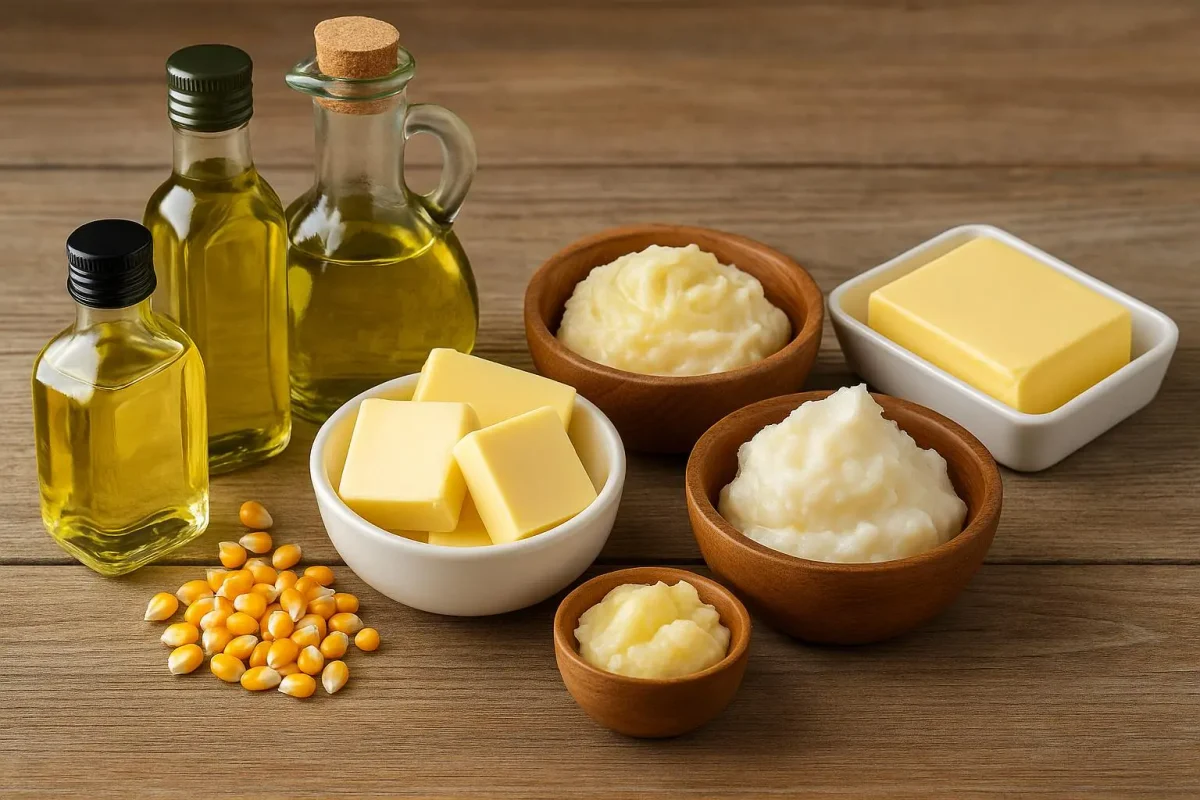
The most significant properties for commercial buyers are fat content, melting characteristics, taste, consistency, storage conditions and use. These properties are important for selecting a formulation for frying, bakery products, confectionery and other production processes.
What Are the Main Vegetable Ghee Uses?
Depending on the formulation, the uses of vegetable ghee are different. There are a variety of fats available, and these are chosen by food businesses based on the cooking temperature, the texture desired in the end product, the flavour profile and the final product requirements.
These are amongst the widespread applications:
- Commercial cooking: Used in suitable formulations for preparing curries, sauces and other cooked dishes.
- Frying: Some formulations may be used for deep or shallow frying as long as they are stable at the frying temperature and in compliance with the manufacturer’s instructions.
- Bakery products: Selected products can be used to add texture, richness and consistency to bakery products.
- Food manufacturing: Formulated fats can be added to processed foods, fillings, coatings and more.
- Food service: High volume food preparation in restaurants, catering companies and institutional kitchens may use appropriate vegetable fats.
Selecting the correct product is based on the application. For instance, bakery shortening and frying shortening have different melting points. It is always important for the buyer to review the product technical data sheet before choosing the product for a specific production process.
Vegetable Ghee vs Butter: What Is the Difference?
Vegetable ghee and butter have varying compositions, functional properties, flavour and source ingredients. Knowledge of these differences enables food producers to select an appropriate ingredient for their formulation and processing needs.
| Feature | Vegetable ghee | Butter |
| Primary source | Processed vegetable oils | Dairy cream or milk |
| Composition | Depends on vegetable oil formulation | Primarily milk fat, with varying water and milk solids |
| Flavour | Mild, neutral or buttery, depending on formulation | Characteristic dairy flavour |
| Texture | Formulated to be solid or semi-solid | Typically solid when chilled, softens when warm |
| Dairy content | Generally dairy-free if no dairy ingredients are added | Contains dairy |
| Applications | Cooking, frying, baking and manufacturing, depending on grade | Cooking, baking, spreading and food preparation |
| Storage | Depends on formulation and packaging | Requires appropriate refrigeration |
| Procurement | Available in industrial and bulk formats, depending on supplier | Available in retail and food-service formats |
The main difference is that while butter is made from milk, vegetable ghee is made with plant-based fats. However, usage of the word “vegetable” ghee does not mean it is free from trans fat, allergens or other ingredients. Purchasers need to confirm the full formulation, processing biotechnology and nutritional statement.
In food businesses that sell products into regulated markets, it is critical to have correct product identification and ingredient labelling. Guidance from the European Commission on food information and labelling provides information about EU requirements for food composition, ingredients and consumer information.
How Is Vegetable Ghee Manufactured?
The manufacture of vegetable ghee is a process that is used to produce edible vegetable oils with desired functional properties. The actual production process depends on the raw materials, consistency desired, melting point and application for the end product.
Common manufacturing processes can involve:
- Selection of raw material: Edible vegetable oils are selected based on the required formulation and quality.
- Oil processing: Based on the source of the oil, oils can be refined to eliminate undesirable impurities, odors, colours and other substances.
- Modification of fat (or blending): Blending, fractionation, hydrogenation or interesterification may be used to obtain the desired texture and melting properties.
- Texture and temperature control: The fat is processed and cooled with controlled temperature and texture to obtain the desired physical structure.
- Quality testing: The final product can be checked for various parameters including appearance, odour, melting profile, moisture, free fatty acids and peroxide value.
- Packaging and storage: Packaged in an appropriate container intended for food use and stored in conditions as indicated by the manufacturer.
Not all manufacturers employ all stages, and hydrogenation should not be assumed. Partially hydrogenated oils may contain EU-restricted industrial trans fats. The European Commission’s trans-fat guidance describes the rules that apply.
Therefore, commercial buyers are advised to ask for an up-to-date specification of the product, ingredient declaration and certificate of analysis, instead of relying on a generic description of vegetable ghee manufacturing.
What Are the Benefits of Vegetable Ghee for Food Businesses?
When the formulation of vegetable ghee matches the intended food application, vegetable ghee can offer practical advantages in commercial food production. Its value is determined by the performance of products, ingredient composition, handling and overall procurement cost.
- Flexibility: Various formulations may be chosen for different frying, baking, cooking and manufacturing processes.
- Repeatable texture, flavour and processing characteristics: A production sample that meets the specification will yield consistent products throughout production.
- Commercial supply arrangements: Can assist with food manufacturers’, wholesalers’ and distributors’ purchasing requirements.
- Fats in formulations: Plant-based fats provide options for developing specific fat formulations or for making products that are free of dairy.
- Packaging flexibility: Bulk packaging can enable businesses to choose the most suitable packaging depending on the supplier’s capacity, while also making deliveries more flexible.
How to Choose a Vegetable Ghee Supplier
Deciding on a vegetable ghee supplier can be a difficult task. While choosing a vegetable ghee supplier, you need to take into account the quality of the product, the delivery time, and the suitability of the company. If the fat doesn’t meet the cooking and market specifications, a low price is not the solution to save money.
When assessing suppliers, here are six steps to take:
Identify your application: Do you require the vegetable ghee for deep frying, baking, restaurants, or wholesale distribution? Make sure to let them know the exact texture you’re looking for.
Check product specifications: Get ingredient lists, technical data sheets, nutrition tables, and certificates of analysis. Review parameters for the job.
Check for quality and compliance records: Ask for food safety systems, local food safety certifications, and batch records. Check these certificates separately.
Evaluate packaging and order quantities: Review types of packages, minimums, pallets, shelf life, and storage needs. Discuss the possibility of holding them at your warehouse.
Compare pricing & logistics: Study the overall quotes, shipping policies, lead times, payment terms, and delivery points. Take into account the total landed cost of the product, not just the unit cost.
Ask for a sample and check if they will be able to supply it: Make a test order with a sample product in your kitchen or factory. Look at batch consistency and overall factory capacity.
Looking for a vegetable ghee supplier in Portugal?
Lagarices – Azeites Do Alentejo LDA is a wholesale and commercial supplier of vegetable ghee. Companies can ask for details regarding bulk orders, product sheets, packaging, and shipping to export destinations.
Explore Lagarices Vegetable Ghee!
Where Can You Buy Bulk Vegetable Ghee?
Suppliers who supply vegetable ghee in bulk should provide clear paper specifications, sufficient containers, and respond to buyers promptly. Papers are also needed for importers and distributors for customs clearance and local food safety inspections.
Lagarices is a supplier to commercial customers in Portugal with vegetable ghee. They have a product page where customers can get in touch with them for bulk orders. Have a discussion with their team to verify order sizes, packaging, formulation information, certificates, and delivery timelines.
When requesting procurement, provide these items:
Required quantity: The amount of the order that must be placed, and when and how often the orders are to be placed.
Product specifications: Purpose of cooking, targeted texture, and technical requirements.
Packaging: Your choice of preferred packaging types and sizes, along with your shipping setup.
Destination: Delivery country, port, or factory address.
Documents: Certificates, export documents, and health declarations required.
This information will be helpful for the supplier to determine the cost and provide an accurate quote.
Frequently Asked Questions
Vegetable ghee is made from processed vegetable oils. Palm oil, palm fractions, or other vegetable fats can be used in the blend. Specific ingredients can be found on the manufacturer’s technical sheet.
No, it is not a product of milk, cream, or butter. Vegetable ghee is prepared from vegetable oils. These have very different flavors as well as fat content, nutrition, and cooking qualities.
It is widely employed in commercial kitchens for cooking, deep frying, baking, and manufacturing in factories. The melting point, thermal stability, and formula are the factors that influence cooking performance.
Not always. The nutritional value will depend on the plant oils employed and the processing used. There are some mixtures high in saturated fat or trans fat. Don’t assume that plant fats are healthier; compare nutrition labels.
The necessary processing of edible plant oils is carried out to obtain the texture and melting point that is desirable in a food product. This can be achieved by refining, blending, fractionation, interesterification, or hydrogenation. The method used is dependent on the product type.
Review supplier technical sheets, ingredient safety, documentation quality and standards, minimum order quantities, shipping capabilities, and production capacity. Do not sign any large supply contract without testing a sample.
Yes. Lagarices is a commercial bulk supplier of vegetable ghee in Portugal. You will be able to contact them and ask for the availability of stock, order minimums, types of containers, prices, and export shipping options.
