
Price per liter. That’s the first thing most buyers ask about, and I get it. It’s the number on the quote. But it’s not where I’d start.
I’d start with a different question: what will actually land on my dock, and will the next load look the same? If you buy extra virgin olive oil for a restaurant group, a distribution business or a food plant, the answer to that is worth more than any discount.
This guide is for U.S. buyers thinking about importing EVOO Olive Oil Wholesale from Portugal. Most of it works for any supplier, though.
So, what does EVOO really mean?
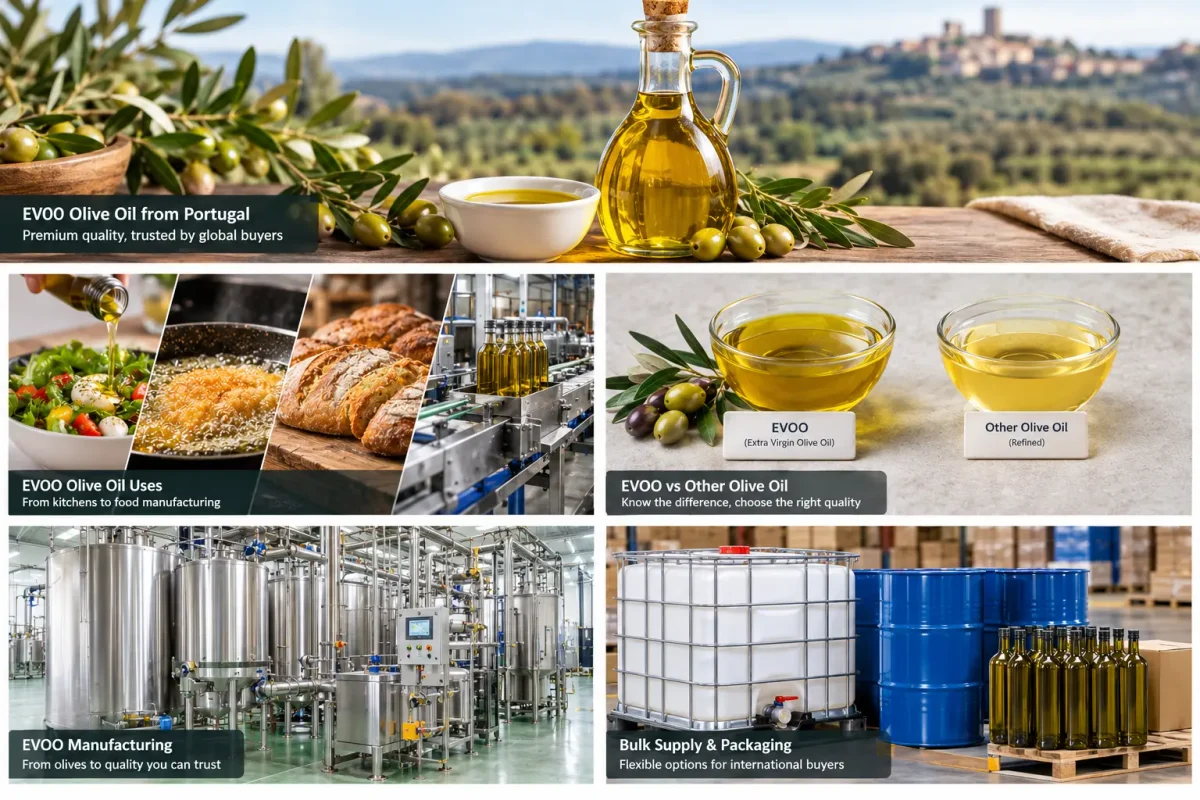
Extra virgin olive oil is the top grade. It comes from olives pressed by mechanical means, with no chemical refining. Ours is cold-pressed, so no heat is used during extraction.
The grade also has rules attached. Under the USDA standard, U.S. extra virgin oil needs excellent flavor and smell, no sensory defects, some fruitiness, and free fatty acidity of 0.8 grams per 100 grams at most. That’s where you get the familiar “under 0.8%” on product pages.
Now, a warning. One lab number can’t describe an oil. I’ve seen oils that pass the test and still taste dull in a real recipe. And a label that only says “olive oil”? It tells you close to nothing. When you ask a supplier about grade, ask which specification the oil is sold under. Get the answer in writing.
Why Portugal
Lagarices – Azeites Do Alentejo LDA sits in Santa Eulália, near Elvas, in the Alentejo. We supply olive oil and other edible oils to distributors, wholesalers, food manufacturers and similar commercial buyers.
What does that mean for an importer in the U.S.? One team handles the oil, the packaging and the shipping documents. You can call a person who knows your order. It sounds minor until a container is at sea and something needs checking at 9 a.m. your time.
We ship worldwide and can adjust packaging to the buyer. More on that below, because packaging is where a lot of deals quietly go wrong.
What to ask before you talk money
A cheap quote can hide a lot. Before you compare numbers, get answers to these.
Which grade and specification applies? “Premium” and “gourmet” are marketing words, not specifications.
Where did the olives grow, and where was the oil pressed? Origin shapes flavor. Your own customers may ask too.
Can I see a Certificate of Analysis? A COA gives test results for one batch, so you’ve got something to check the delivery against.
Can you trace my batch? If there’s a problem, you need to know which production run it came from.
And what happens if the shipment doesn’t match the agreed specification? A good supplier answers this straight away. A weak one gets vague.
Then there’s the big one. Can you give me the same quality next time? Anyone can ship one good order. A wholesale relationship is about order number five, or ten, or twenty.
Send these questions by email. You’ll have everything on paper, and you’ll learn how the supplier communicates before any money moves. That tells you a lot.
Packaging comes first, quote second
Look at your own setup. Storage tanks? A loading dock and a forklift? A filling line? Or do you split the oil into smaller lots for your own customers?
Your answers decide the format. A manufacturer with proper storage may prefer drums, IBCs or flexitanks. A distributor with many small buyers might want containers that are easy to handle and share out. Smaller businesses often go for cans or bottles.
There isn’t one right choice. The trap is simple, though: you collect three quotes, pick the lowest, and later find out the packaging doesn’t fit your warehouse. Repacking, extra handling, odd freight. The cheap oil isn’t cheap anymore.
So before you ask for a price, tell the supplier how much oil you need, how you’ll receive it and how much you can store. We can customize packaging, but only if we know what you’re working with.
A restaurant and a factory want different things
Buyers mix this up a lot.
Restaurants use EVOO for dressings, marinades, dipping, finishing, and sometimes cooking. Flavor leads. Drizzle it over a finished plate and the guest tastes it straight away, so aroma and fruitiness matter. Stir it into a sauce where the olive note is quiet, and you can judge it more loosely. A group with several locations will also want different volumes and steadier deliveries than a single independent kitchen.
A food manufacturer worries about something else. Sameness. When olive oil is an ingredient in a commercial recipe, a small change in the raw material can show up in the finished product. The sauce looks a bit different. The dressing separates in a new way. The taste moves just enough for a customer to notice. For these buyers, a stable specification beats a perfect tasting note.
Private-label companies sit between the two. They need oil that meets an agreed specification, and often help with packaging and labeling as well. If that’s you, say it in your first message. It saves a round of emails.
Test the sample in the real thing
A sample is useful. You see the color, smell the oil, taste it. What you don’t see is how it behaves in your process.
Manufacturers: run a small production trial before you approve anyone. Same recipe, same equipment, same timing. A little effort now can spare you a bad batch later.
Restaurants: taste the oil in actual dishes. Not on a spoon, not on bread. Dressings and hot dishes change how an oil comes across, so try a few before you commit to a bigger volume.
The U.S. import side
Getting food into the United States takes more than booking a ship.
The FDA says imported food has to meet U.S. requirements. Foreign food facilities generally need to register. Importers have to follow the import procedures, including Prior Notice, which tells the FDA about a shipment before it arrives.
Many importers also come under the Foreign Supplier Verification Program (FSVP). In plain terms, covered importers must run risk-based checks to confirm that foreign suppliers make food that meets U.S. safety rules and isn’t adulterated or misbranded.
I’m not a lawyer, and the details depend on your business, your product and any exemptions. Check your own case with a customs broker or compliance specialist. Don’t assume every shipment follows the same path.
What a supplier can do is make your side easier. Clear product details and shipping documents, sent on time. When paperwork turns up late, cargo waits and costs climb.
Mistakes worth avoiding
- Choosing on price alone. The lowest quote often leaves something out that you pay for later.
- Skipping the specification. “Extra virgin” on a label isn’t enough.
- Ignoring storage. Know how you’ll receive and keep the oil before you order, and keep it away from heat and light.
- Not testing. Approving a supplier from a sample description is a gamble.
- Forgetting the repeat order. One good shipment proves very little.
- Leaving compliance for the end. Call your broker early.
None of this is hard. It just slips through when people are busy.
How to order from Lagarices
Keep it simple. Tell us how much EVOO you need, which packaging you prefer, any specification you must meet, and where it should be delivered.
Send that to sales@lagaricelda.com or call +351 924 699 605. The office is open from 08:00 to 17:00, Portugal time. After that we can talk through your needs and see what makes sense.
You can read more on our EVOO olive oil suppliers in Portugal page. We also supply other edible oils, so if you buy more than one product, one conversation can cover it all.
