

If you are searching for what is sunflower oil, the simple answer is that it is a vegetable oil extracted from sunflower seeds. But for someone buying it for a food business, that definition only covers the starting point. The variety of sunflower used, the way the oil is processed, the final specification and even the packaging can make a meaningful difference.
Sunflower oil is used across the food industry, from everyday cooking and frying to bakery products, sauces, dressings, snacks and packaged foods. In the U.S. market, it is also relevant to importers, distributors and food manufacturers looking for dependable bulk supplies.
What Is Sunflower Oil?
Sunflower oil is extracted from the seeds of the sunflower plant, Helianthus annuus. After extraction, the crude oil can be refined to improve its color, odor, flavor and overall consistency.
There is no single version of sunflower oil. Conventional, mid-oleic and high-oleic varieties can have different fatty-acid profiles and may be selected for different food applications. The U.S. Department of Agriculture’s specifications, for example, include mid-oleic sunflower oil as a defined commercial product and describe refined, bleached and deodorized sunflower oil as a finished form.
For a household shopper, these distinctions may not matter much. For a food manufacturer purchasing several thousand gallons, they can be important.
What Is Sunflower Oil Made From?
It starts with sunflower seeds.
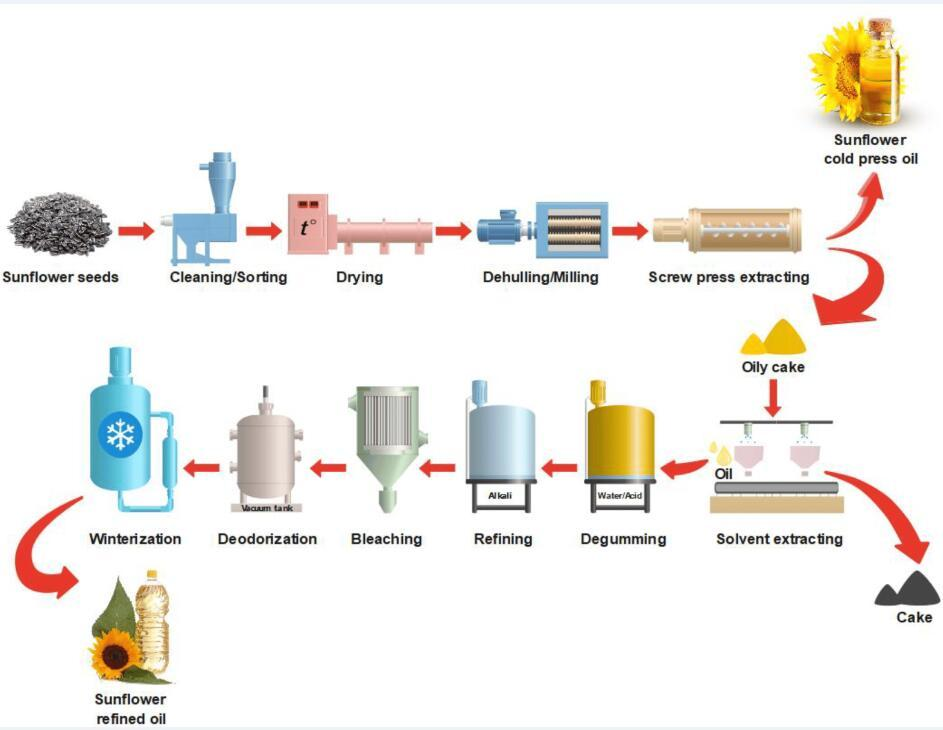
Once harvested, the seeds are cleaned and prepared before the oil is extracted. The crude oil then goes through further processing when a refined product is required.
A typical production route may include:
- Cleaning and preparing the seeds
- Extracting the oil
- Clarifying the crude oil
- Refining
- Bleaching
- Deodorization
- Additional processing where the specification requires it
- Laboratory testing and packaging
The exact process depends on the raw material and the grade being produced. This is one reason a buyer should not judge two oils simply by calling both of them “sunflower oil.” Their specifications may be quite different.
How Is Sunflower Oil Refined?
Crude sunflower oil contains naturally occurring compounds that can influence its appearance, smell, flavor and stability. Refining is used to reduce or remove many of these components.
A refined sunflower oil process can include degumming, neutralization, bleaching and deodorization. Some products may also require additional treatment, such as winterization.
The practical objective is straightforward: produce an oil with characteristics that are suitable for its intended use and reasonably consistent from batch to batch.
Lagarices describes its own production process as including refining, bleaching and deodorization, with laboratory monitoring of parameters such as free fatty acids, peroxide value, moisture and color.
For commercial buyers, this type of quality control matters more than a supplier simply describing an oil as “premium.”
What Are the Different Types of Sunflower Oil?
The term sunflower oil covers several different products.
Conventional Sunflower Oil
Conventional sunflower oil is commonly used for cooking and general food applications. Its relatively neutral flavor makes it useful when the oil should not overpower the taste of the finished product.
Mid-Oleic Sunflower Oil
Mid-oleic sunflower oil contains more oleic acid than traditional high-linoleic sunflower oil. USDA specifications define requirements for this type of refined sunflower oil, making it a distinct commercial category rather than simply another name for conventional oil.
High-Oleic Sunflower Oil
High-oleic sunflower oil comes from sunflower varieties bred to produce a higher proportion of oleic acid. It is often considered where fatty-acid composition and oxidative stability are important to the application.
For businesses, choosing between these types should come down to the product being manufactured and the specification required—not simply which one is available.
What Is Refined Sunflower Oil Used For?
Refined sunflower oil is used in a surprisingly wide range of food products.
Common applications include:
- Commercial and industrial frying
- Potato chips and other snacks
- Bakery and confectionery products
- Mayonnaise
- Sauces and dressings
- Foodservice
- Packaged foods
- Retail cooking oil
- Private-label products
- Food manufacturing
Its relatively neutral sensory profile is particularly useful when manufacturers want the ingredients in the finished product to retain their intended taste.
Sunflower oil is also used for deep frying. The USDA Food Safety and Inspection Service includes sunflower oil among oils that can be used for deep frying, while also noting that frying performance varies between oils and operating conditions.
That last point is worth remembering. A laboratory specification does not tell the whole story about how an oil will behave in a particular fryer. Temperature, food type, filtration, turnover and storage conditions all matter.
Why Do Food Manufacturers Choose Sunflower Oil?
There is no single reason.
For some manufacturers, the main attraction is its relatively neutral flavor. For others, it may be the type of fatty-acid profile, availability, versatility or compatibility with a particular production process.
Packaging also plays a role.
A small foodservice customer may need jerry cans or drums, while a large manufacturer could receive oil in IBCs, flexitanks or bulk tankers. Lagarices lists several commercial packaging formats, including PET bottles, jerry cans, drums, IBCs, flexitanks and tanker deliveries.
In other words, buying sunflower oil is not only about the oil itself. The supply format has to make sense for the buyer’s operation.
What Should U.S. Buyers Check Before Importing Sunflower Oil?
This is where the purchasing process becomes more serious.
A U.S. importer or food manufacturer should look beyond the quoted price and ask a few practical questions.
What exactly is being supplied?
The product specification should identify the grade and relevant quality parameters.
Can the supplier provide batch documentation?
A Certificate of Analysis can help buyers check whether a shipment meets the agreed specification.
Where does the oil come from?
Raw-material origin, refining location and country of dispatch are not necessarily the same thing. Buyers should clarify each separately.
How is the product packaged?
The chosen format should match the receiving facility, storage capacity and handling equipment.
Can the supplier provide the required documentation?
Importers should establish documentation requirements before placing a large order rather than discovering a missing document after shipment.
U.S. businesses should also consider applicable FDA requirements based on the product and its intended use. The FDA maintains regulatory information relating to sunflower oil and food-related applications.
Refined vs. Unrefined Sunflower Oil
The main difference is the degree of processing.
Refined sunflower oil is processed to reduce unwanted components and produce more controlled sensory and technical characteristics. Unrefined oil undergoes less processing and generally retains more of the characteristics associated with the original seed.
Neither option is automatically right for every application.
A food manufacturer making a product with a specific flavor profile may have different requirements from a company running a high-volume frying operation. The intended use should therefore come first.
How to Choose a Sunflower Oil Supplier
Before committing to a new supplier, a buyer should be able to get clear answers to some basic questions:
- What grade of sunflower oil is supplied?
- What are the agreed specifications?
- Is a Certificate of Analysis available?
- What packaging formats are offered?
- What is the minimum order quantity?
- What are the expected lead times?
- Can export documentation be provided?
- How is batch traceability handled?
- Can the supplier support repeat orders?
For international buyers, it is also sensible to evaluate a supplier’s ability to maintain the same agreed specification across recurring shipments.
Lagarices – Azeites Do Alentejo LDA identifies refined sunflower oil as a core product and supplies food manufacturers, distributors, private-label businesses and industrial buyers. Its published product information also describes laboratory quality monitoring and multiple bulk packaging options.
Is Sunflower Oil Suitable for Commercial Frying?
Yes. Sunflower oil is used in commercial and industrial frying applications, including foodservice and snack production. USDA FSIS lists sunflower oil among oils suitable for deep frying.
Still, choosing an oil for a commercial fryer should involve more than looking at its smoke point.
The frying temperature, type of food, length of use, filtration system, oil turnover and storage conditions can all affect performance. Food manufacturers should ideally conduct their own application testing before moving from a sample to large-volume procurement.
Finding the Right Sunflower Oil for Your Application
Knowing what sunflower oil is is only the first step. For U.S. food manufacturers, importers and distributors, the more useful question is whether a particular sunflower oil matches the intended application and purchasing requirements.
A good supplier conversation should therefore cover the product specification, quality documentation, origin, packaging and delivery arrangements before the order is finalized.
FAQ
Yes. It is extracted from the seeds of the sunflower plant, Helianthus annuus.
It is sunflower oil that has undergone controlled processing to reduce unwanted components and produce characteristics suitable for specific food applications.
Yes. It is used for both commercial and household frying. The appropriate grade depends on the application and operating conditions.
No. Sunflower oil can vary according to sunflower variety, fatty-acid profile, refining process and finished-product specification.
Check the product specification, Certificate of Analysis, origin, traceability, packaging, documentation, logistics and suitability for the intended application.
