
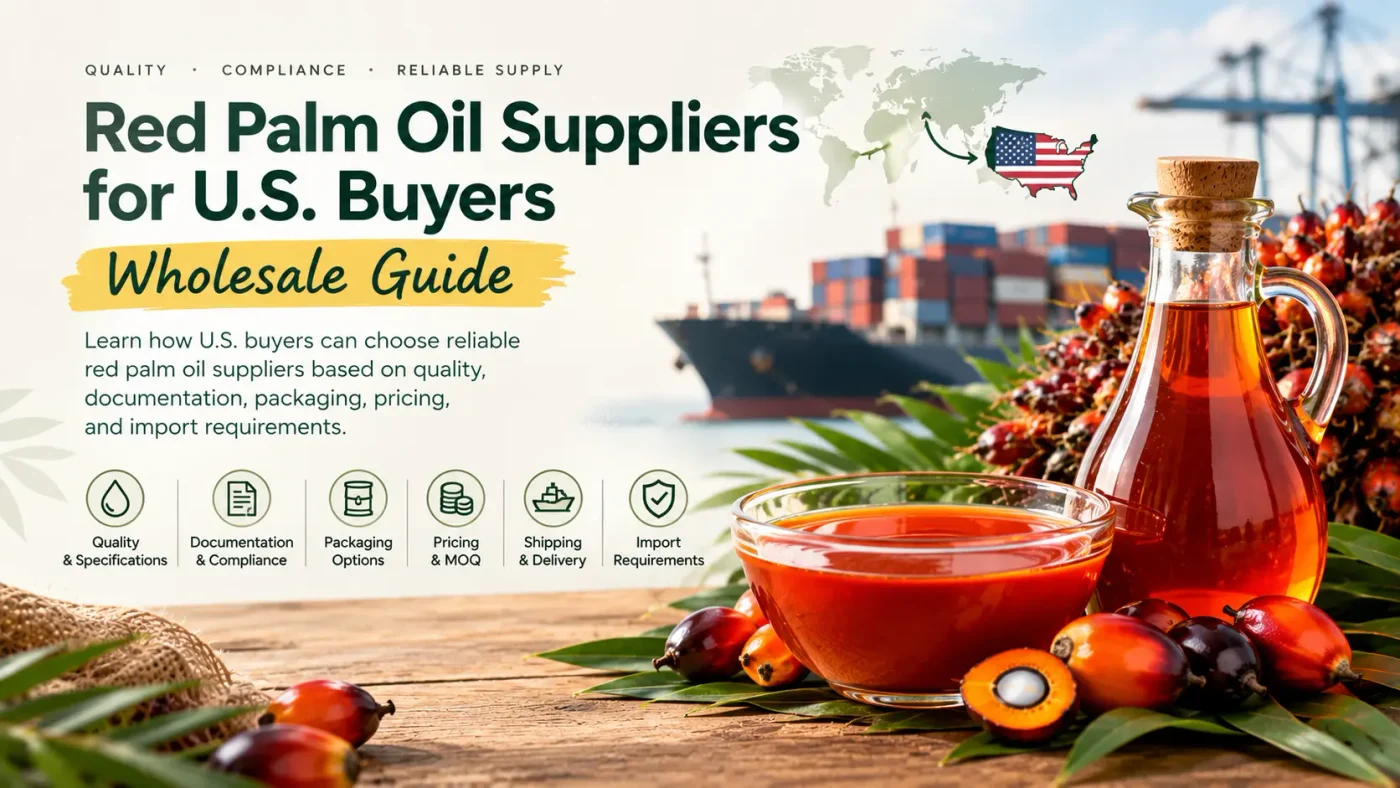
For a U.S. food business, buying red palm oil is not simply a matter of finding a supplier with a competitive price. Once the purchase involves drums, IBCs, containers, or regular commercial shipments, the supplier becomes part of the company’s wider supply chain.
That makes red palm oil supplier selection an important purchasing decision. A suitable supplier needs to provide the right product, consistent quality, useful documentation, dependable packaging, and reliable communication. For companies sourcing from Portugal or other international markets, import requirements also need to be considered before an order is placed.
This guide explains the practical points U.S. buyers should review when choosing a red palm oil supply partner.
What U.S. Businesses Look for in Red Palm Oil
Red palm oil is different from highly refined palm oil. Its color, flavor and product characteristics can make it suitable for particular food applications, depending on the buyer’s formulation and specification.
Before contacting suppliers, a business should first define what it actually needs. The required product may depend on the final application, packaging format, expected order volume and storage conditions.
A buyer may need information such as:
- Product description and grade
- Origin
- Processing method
- Physical and chemical specifications
- Packaging format
- Shelf-life information
- Storage recommendations
- Minimum order quantity
- Available shipment sizes
Having these requirements ready makes supplier comparisons much easier. It also reduces the risk of receiving quotations for products that are not actually comparable.
What Makes a Reliable Red Palm Oil Supplier?
A supplier can offer an attractive price and still create problems later if specifications change, documents are incomplete or shipments are inconsistent.
For U.S. wholesale buyers, reliability usually comes down to several practical areas.
Consistent Product Specifications
The oil supplied should match the specification agreed before the purchase. Buyers should request a current product specification sheet and, where appropriate, a Certificate of Analysis (COA) for the relevant batch.
The COA should be reviewed against the agreed specification rather than simply filed away as paperwork. Parameters relevant to the product and intended use should be clearly identified.
If a supplier cannot explain its specifications clearly, that is worth investigating before making a large purchase.
Quality Control
A professional supplier should have a defined quality-control process covering incoming raw materials, processing and finished products.
For larger U.S. buyers, it can be useful to ask:
- Where is the oil produced?
- How is each batch identified?
- What testing is performed?
- Is batch documentation available?
- How are quality complaints handled?
- What happens if a shipment does not meet specification?
These questions tell a buyer much more about a supplier than a sales presentation does.
Documentation Matters for U.S. Buyers
International food purchases involve more documentation than a domestic wholesale order.
A U.S. importer should understand which documents are required for the particular product and shipment and should work with its customs broker and compliance team where necessary.
Supplier documentation may include:
- Commercial invoice
- Packing list
- Certificate of Analysis
- Product specification
- Country-of-origin information
- Shipping documents
- Food safety documentation
- Traceability records
- Relevant certifications, where applicable
The exact requirements depend on the product, transaction and regulatory circumstances, so buyers should confirm them before shipment rather than after the cargo is already on its way.
Understanding FSVP Before Importing
For U.S. businesses importing food from a foreign supplier, the Foreign Supplier Verification Program (FSVP) is an important consideration.
FDA explains that covered U.S. importers must perform risk-based activities to verify that foreign suppliers are producing food in a manner that provides the applicable level of public-health protection and that the food is not adulterated. FSVP activities can include supplier evaluation, hazard analysis, verification activities, corrective actions and recordkeeping.
This means the relationship between a U.S. importer and a foreign supplier should not stop at agreeing on price and delivery.
A buyer may need information from the supplier to support its FSVP responsibilities. FDA notes that importers can request information from foreign suppliers to meet those requirements.
For this reason, a supplier that responds quickly to documentation requests can be much easier to work with over the long term.
Bulk Packaging Should Match the Business
Packaging is another area that is easy to overlook when comparing suppliers.
A small food company may have completely different requirements from a large food manufacturer. Depending on the supplier and product, commercial oil may be available in drums, intermediate bulk containers or larger bulk transportation formats.
U.S. buyers should consider:
- Order volume
- Warehouse capacity
- Handling equipment
- Expected consumption rate
- Transportation requirements
- Storage conditions
- Packaging disposal or recycling
- Whether the oil will be repacked after import
The cheapest packaging option is not necessarily the most economical if it creates additional handling or storage costs.
A supplier should also clearly identify the packaging used for each quotation so that different offers can be compared fairly.
Price Is Important, but It Should Not Be the Only Factor
Wholesale buyers naturally want a competitive price. However, comparing only the quoted price per kilogram or metric ton can give a misleading picture.
The real purchasing cost may also include:
- Packaging
- Freight
- Insurance
- Port charges
- Customs-related costs
- Storage
- Inland transportation
- Testing
- Additional documentation
- Potential delays
A slightly higher product price may make commercial sense if the supplier offers better consistency, documentation and delivery reliability.
For U.S. importers, it is often more useful to compare the total landed cost rather than the supplier’s product price alone.
Check Supply Capacity Before Scaling Up
A supplier may be able to handle one small order but struggle when demand increases.
This matters particularly for distributors, food manufacturers and private-label companies that expect regular purchases.
Before moving to a larger agreement, ask about:
- Normal production capacity
- Available shipment sizes
- Lead times
- Order scheduling
- Peak-season availability
- Export experience
- Backup supply arrangements
- Communication during delays
A supplier does not need to promise unlimited availability. What matters is whether the supplier can realistically support the buyer’s expected purchasing schedule.
How to Evaluate Red Palm Oil Suppliers Portugal
For companies specifically researching red palm oil suppliers Portugal, the same basic supplier-selection principles apply.
The buyer should look beyond a supplier’s location and evaluate the actual business relationship.
A practical comparison can include:
| Factor | What the Buyer Should Check |
| Product | Exact grade and intended application |
| Quality | Specification and batch testing |
| Documentation | COA, traceability and relevant records |
| Packaging | Drums, IBCs or other available formats |
| MOQ | Minimum commercial order |
| Lead time | Production and shipping schedule |
| Export | Experience with international shipments |
| Communication | Response time and documentation support |
| Price | Product price and total landed cost |
| Consistency | Ability to meet the same specification over time |
This approach is more useful than selecting a supplier simply because it appears high in a search result.
Ask for a Sample Before a Large Order
For a new supplier, a sample or smaller commercial trial can be a sensible first step where practical.
The buyer can evaluate whether the product performs as expected in its own application and compare the supplier’s documentation with the physical product.
For food manufacturers, internal testing may be particularly important because the oil can interact with the company’s existing recipe, processing conditions and finished product.
The goal is not just to determine whether the oil looks acceptable. It is to establish whether the product fits the company’s actual requirements.
Common Mistakes U.S. Buyers Should Avoid
Several mistakes can make international oil sourcing more complicated than it needs to be.
Choosing entirely on price: A low quotation may not represent the lowest total cost.
Skipping documentation checks: Missing or inconsistent paperwork can cause delays and complicate supplier verification.
Ordering too much too soon: A large first shipment creates unnecessary exposure if the product or supplier does not perform as expected.
Ignoring packaging requirements: The right oil in the wrong packaging can create warehouse and handling problems.
Failing to define specifications: If the buyer and supplier are working from different product specifications, disagreements are more likely.
Treating every shipment as identical: Batch documentation and quality checks remain important, especially for regular commercial supply.
Questions to Ask a Supplier Before Ordering
Before signing a long-term supply agreement, a U.S. buyer can ask:
- What exact red palm oil specification are you offering?
- Can you provide a current COA?
- What testing is performed on each batch?
- What bulk packaging options are available?
- What is the minimum order quantity?
- What is the normal production lead time?
- Can you provide traceability information?
- What export documentation is supplied?
- What experience do you have with U.S. shipments?
- How are quality complaints or rejected batches handled?
Clear answers to these questions help separate a dependable supply partner from a supplier that is simply offering a product for sale.
Building a Long-Term Supply Relationship
The best supplier relationship is usually built gradually.
A buyer can start by defining specifications, reviewing documentation, testing a sample or initial shipment, and evaluating delivery performance. If everything works as expected, purchasing can then move toward regular orders.
Communication becomes increasingly important at this stage. Changes in raw materials, specifications, packaging or delivery schedules should be communicated before they affect the customer.
For U.S. businesses, this kind of supplier relationship can make international purchasing easier to manage. It also gives both sides a clearer understanding of expectations.
Final Thoughts for U.S. Red Palm Oil Buyers
Choosing a reliable red palm oil supplier should involve more than comparing quotations. Product specifications, quality control, documentation, packaging, supply capacity and U.S. import responsibilities all deserve attention.
For buyers researching red palm oil suppliers Portugal, the most useful approach is to compare suppliers using the same checklist and request the same core information from each company. That creates a fairer comparison and makes it easier to identify the supplier that fits the business rather than simply the supplier offering the lowest initial price.
For U.S. importers, it is also important to remember that FSVP responsibilities generally fall on the applicable U.S. importer, while information from the foreign supplier may be needed to support the verification process.
A reliable supply partner is ultimately one that can provide the right product, consistent documentation, practical packaging and dependable communication shipment after shipment.
