
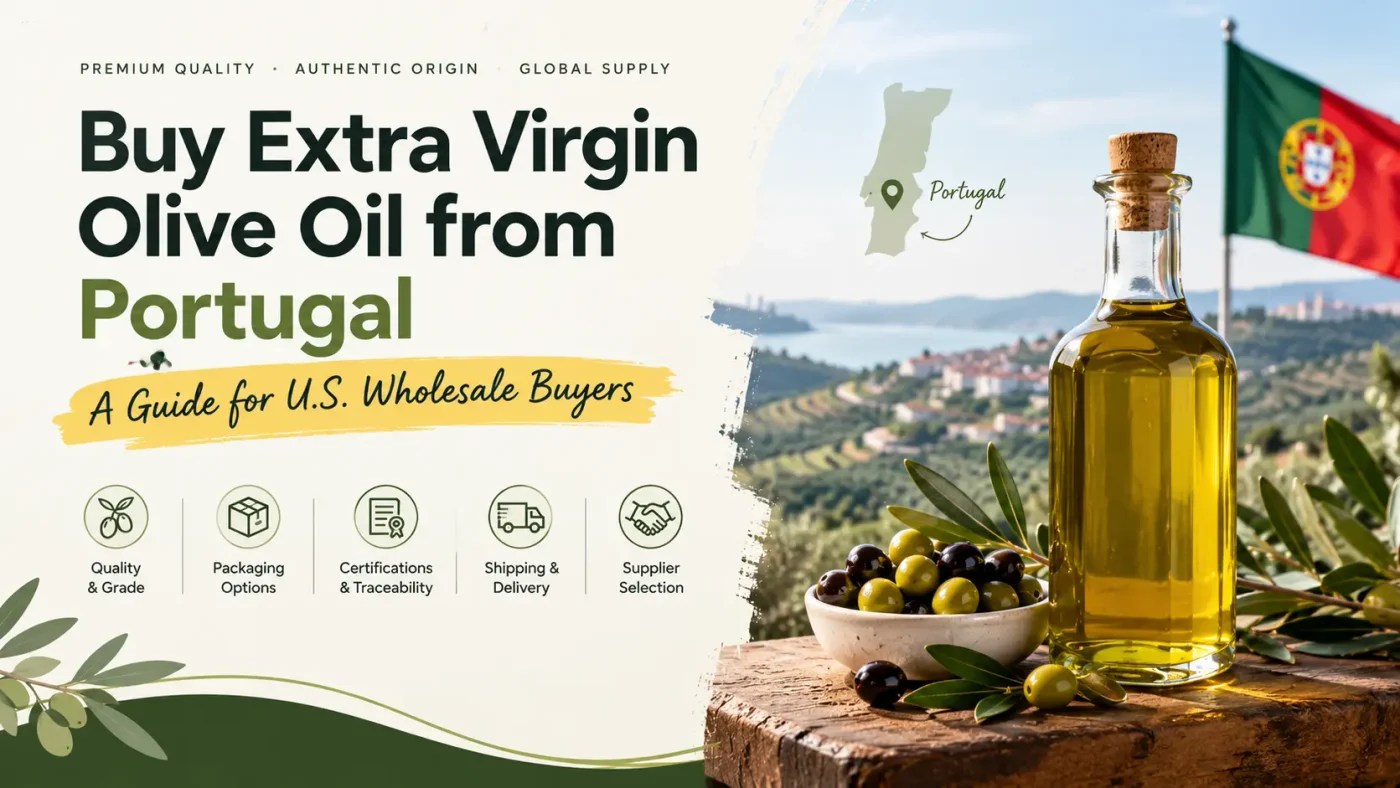
Buying extra virgin olive oil for a U.S. business is very different from picking up a bottle from a supermarket shelf.
A restaurant may go through several cases a month. A distributor may need a much larger shipment. A food manufacturer or private-label company may be looking for bulk oil that can be stored, processed, bottled, or supplied to customers under an agreed specification.
In all of these situations, the question is not simply where to buy olive oil. The buyer needs to find a Portuguese supplier that can provide the right product, in the right quantity, with the documentation and packaging needed for the U.S. market.
Portugal is already an established exporter of virgin olive oil. In 2024, Portugal exported about 195.9 million kg of virgin olive oil and related fractions under HS 150910, with the United States receiving about 2.01 million kg.
For U.S. wholesale buyers, that makes Portugal worth considering—but supplier selection still needs to be handled carefully.
Why Buy Extra Virgin Olive Oil from Portugal?
Portugal has a long olive-growing and olive-oil production tradition, but a buyer should look beyond the country’s reputation.
The more useful question is whether a particular supplier can provide an oil that fits the buyer’s requirements.
For a U.S. business, those requirements may include:
- Extra virgin grade
- Specific sensory characteristics
- Agreed technical parameters
- Bulk or commercial packaging
- Batch documentation
- Traceability
- Reliable shipment schedules
- Repeat-order capacity
The supplier’s ability to meet these requirements matters more than simply having a Portuguese address.
Portugal’s export relationship with the U.S. is also not just theoretical. World Bank trade data shows Portugal exported virgin olive oil and related products to the United States in 2024, demonstrating an existing trade flow between the two markets.
What Should U.S. Buyers Look for in Portuguese EVOO?
The first step is to define what the business actually needs.
A restaurant looking for olive oil for dressings and finishing may have different requirements from a manufacturer using the oil as an ingredient. A distributor may be more concerned with packaging, volumes, and delivery schedules.
Before contacting suppliers, it helps to have a basic purchasing brief ready.
For example:
Product: Extra virgin olive oil
Market: United States
Quantity: Required monthly or annual volume
Application: Foodservice, manufacturing, retail, etc.
Packaging: Bulk, drums, IBCs, bottles, or other format
Delivery: Required destination and preferred schedule
This makes supplier conversations much more useful. Instead of receiving a generic price list, the buyer can ask for an offer based on an actual requirement.
Check the Grade Before Comparing Prices
The term “extra virgin” should not simply be treated as a marketing description.
The USDA’s U.S. grade standard defines Extra Virgin Olive Oil using both sensory and chemical requirements. The standard specifies excellent flavor and odor, positive fruitiness, no detectable sensory defects under the specified grading method, and free fatty acidity of no more than 0.8 grams per 100 grams, along with other requirements.
For a U.S. wholesale buyer, this is a good reason to request the supplier’s specification before placing a large order.
The buyer should know exactly what is being offered and what quality information supports the product.
It is also worth remembering that a product’s commercial suitability cannot always be judged from one number. Sensory characteristics, intended use, storage, packaging, and batch information can all matter.
Ask for a Certificate of Analysis
A supplier’s product description is useful, but a wholesale buyer normally needs more than a description.
A Certificate of Analysis (COA) can provide test results for a specific batch. Depending on the supplier and purchasing requirements, documentation may include parameters such as free fatty acidity, peroxide value, sensory information, and other relevant tests.
The exact documents required will depend on the product and the buyer’s needs.
For larger purchases, it is also sensible to ask how batches are identified and how traceability is maintained.
This becomes particularly useful when the same product is being purchased repeatedly. If there is ever a question about a shipment, both sides need to be able to identify what was supplied and when.
Bulk EVOO Packaging for U.S. Buyers
Packaging needs to be discussed early.
A U.S. distributor may want commercial containers that can be stored and redistributed. A food manufacturer may have its own bulk storage system. A private-label company may want the oil supplied in a format suitable for its filling operation.
Depending on the supplier, bulk purchasing may involve formats such as drums, IBCs, flexitanks, or other commercial arrangements.
The important point is that the cheapest packaging is not necessarily the most practical.
A buyer should consider how the oil will arrive at the facility, how it will be unloaded, where it will be stored, and how it will eventually be used.
A large-volume order only makes sense if the receiving operation can handle it.
Don’t Compare Suppliers on Price Alone
This is where many wholesale purchases become difficult.
One supplier may quote a lower price but have a larger minimum order. Another may include different packaging. A third may offer shorter lead times or more suitable documentation.
So when comparing Portuguese suppliers, look at the landed commercial offer, not only the quoted price of the oil.
Consider:
- Product price
- Quantity
- Packaging
- Freight
- Insurance where applicable
- Delivery terms
- Lead time
- Minimum order
- Documentation
- Payment terms
- Repeat-order conditions
A slightly higher product price may make sense if the overall supply arrangement works better for the buyer.
What About U.S. Import Requirements?
Importing olive oil into the United States also requires attention to FDA requirements.
The FDA states that imported food must meet applicable U.S. requirements, including safety, sanitary, and labeling requirements. Food facilities that manufacture, process, pack, or hold food may need to be registered with FDA, and applicable shipments are subject to Prior Notice requirements. Imported food can also be inspected when offered for entry into the United States.
For covered U.S. importers, the Foreign Supplier Verification Program (FSVP) can also be relevant. The importer has responsibilities for risk-based verification of foreign suppliers and the food they provide.
The exact requirements depend on the circumstances, so an importer should confirm which rules apply to its own business and shipment.
For this reason, it helps to work with a Portuguese supplier that understands export documentation and can provide the information needed for the transaction.
Bulk Olive Oil or Finished Bottles?
The right option depends on what the U.S. business is trying to do.
A food manufacturer with its own filling or storage operation may prefer bulk oil.
A distributor may want commercial containers that can be supplied to different customers.
A private-label business may want finished bottles with its own branding and labeling.
There is no single answer for every buyer.
The important thing is to decide the supply model before requesting quotations. Otherwise, suppliers may be quoting completely different products or services while appearing to compete on the same price.
Questions to Ask a Portuguese Olive Oil Supplier
Before moving forward with a new supplier, a U.S. buyer can ask:
- What grade of olive oil are you supplying?
- Where is the oil produced?
- What is the product specification?
- Can you provide a COA for the relevant batch?
- What packaging formats are available?
- What is the minimum order quantity?
- What is the expected lead time?
- How is the product batch identified?
- What export documentation is provided?
- Can you supply the same specification on repeat orders?
- Can you provide samples before a larger purchase?
- What are the delivery terms to the United States?
The answers give the buyer a much clearer picture than a price quotation alone.
Sample Testing Before a Large Order
A sample is worth considering before committing to a substantial shipment.
For a restaurant or foodservice business, the team can evaluate the oil in the applications where it will actually be used.
For a manufacturer, it can be tested in the relevant recipe or production process.
This does not replace formal documentation, but it gives the buyer practical information about whether the oil fits the intended application.
For a long-term supply arrangement, the goal is not just to approve one sample. The buyer also needs confidence that future shipments will meet the agreed requirements.
What Makes a Good Supplier for U.S. Wholesale Buyers?
A good supplier relationship is usually built around consistency.
The supplier should be able to communicate clearly about the product, documentation, packaging, production schedule, and shipment.
The buyer should also know who is responsible for each part of the process.
For example, if the oil is being imported into the U.S., the buyer should understand which party is handling shipping documentation, customs-related arrangements, and other applicable import procedures.
Clear responsibilities reduce confusion later.
Lagarices – Azeites Do Alentejo LDA can be considered by B2B buyers alongside other potential suppliers when evaluating Portuguese edible-oil sourcing. The final decision should be based on the specific product specification, available packaging, documentation, commercial terms, and requirements of the U.S. buyer.
A Practical Approach to Buying Portuguese EVOO
For a U.S. business, buying extra virgin olive oil from Portugal does not have to be complicated.
Start with the product requirement. Decide how much oil is needed, how it will be used, and how it needs to be delivered.
Then compare suppliers on more than price.
Look at the product specification. Ask for relevant batch documentation. Check the packaging. Understand the delivery terms. Make sure the supplier can support the volume required and, if the relationship is intended to continue, ask about repeat supply.
Most importantly, treat the first order as the beginning of a supply relationship rather than a one-time transaction.
That approach gives U.S. wholesale buyers a much better basis for choosing a Portuguese EVOO supplier and building a supply arrangement that can work beyond the first shipment.
Yes. U.S. businesses can source olive oil from Portuguese suppliers, subject to applicable U.S. import, food safety, labeling, and documentation requirements.
Ask about the product grade, specification, origin, COA, packaging, minimum order, lead time, traceability, export documentation, and repeat-order capacity.
Yes. A Certificate of Analysis can provide batch-specific test information and help the buyer compare the shipment against the agreed specification.
Yes. Portugal already exports virgin olive oil to the United States, with World Bank trade data recording approximately 2.01 million kg of virgin olive oil and related fractions exported from Portugal to the U.S. in 2024.
It depends on the business. Manufacturers and companies with suitable storage or filling facilities may prefer bulk supply, while distributors or private-label businesses may require different packaging arrangements.
